
Modern browsing feels effortless, yet that speed is the result of decades of remarkable innovation. The tech ideas that made the web move quicker transformed slow dial-up connections into a lightning-fast digital ecosystem that powers streaming, cloud software, online shopping, and real-time communication. Every webpage now benefits from intelligent technologies working together to reduce delays and improve reliability. From broadband networks and advanced communication protocols to browser optimisation and distributed infrastructure, each breakthrough has played a vital role. Understanding the tech ideas that made the web move quicker helps you appreciate how today’s internet delivers faster experiences while highlighting the importance of website loading speed, web performance optimization, high-speed internet, modern web architecture, and low latency network solutions.
What Are the Tech Ideas That Made the Web Move Quicker?
The phrase tech ideas that made the web move quicker describes the groundbreaking technologies that transformed a sluggish internet into today’s responsive digital ecosystem. These innovations improved how information travels, how browsers display pages, and how servers deliver content efficiently. Instead of relying on a single breakthrough, the web evolved through decades of collaboration among engineers, researchers, and technology companies. Together, internet speed improvements and modern web architecture reshaped online communication in remarkable ways.
Imagine a busy motorway replacing a narrow country road. Cars reach their destination faster because the route becomes wider, smarter, and less congested. The internet followed a similar journey. Technologies such as broadband, caching, cloud computing, and faster communication protocols worked together to eliminate delays. Today, every webpage benefits from high-speed internet and low latency network improvements that operate silently behind the scenes.
Why Web Speed Matters for Users, Businesses, and SEO
Nothing drives visitors away faster than a slow website. People expect pages to appear almost instantly, especially when shopping, reading news, or using online services. Even a brief delay can reduce trust and increase bounce rates. That is why tech ideas that made the web move quicker have become essential for both user satisfaction and business success. Strong SEO page speed and excellent user experience optimization often influence whether visitors stay or leave.
Search engines also reward websites that perform efficiently. Google’s Core Web Vitals encourage website owners to improve loading speed, responsiveness, and visual stability. Faster websites usually attract better engagement, stronger rankings, and higher conversions. Businesses investing in server response time improvements and browser performance optimisation often gain a competitive advantage because visitors enjoy smoother browsing experiences across every device.
The Evolution of Web Speed: A Timeline of Major Innovations
The journey towards today’s lightning-fast internet began with dial-up connections during the 1990s. Although revolutionary at the time, those connections struggled with large files and busy networks. Broadband arrived and changed everything. Soon afterwards, technologies including CDNs, cloud computing, and compression created another leap forward. These tech ideas that made the web move quicker steadily removed bottlenecks while making websites more dependable.
Innovation didn’t stop there. Mobile networks advanced from 3G to powerful 5G connections, browsers introduced smarter rendering engines, and developers embraced modern optimisation techniques. New protocols such as HTTP/3 reduced communication delays, while image formats became dramatically smaller without sacrificing quality. Combined with website acceleration and bandwidth optimization, these improvements continue shaping the future of the internet.
The Most Important Tech Ideas That Made the Web Move Quicker
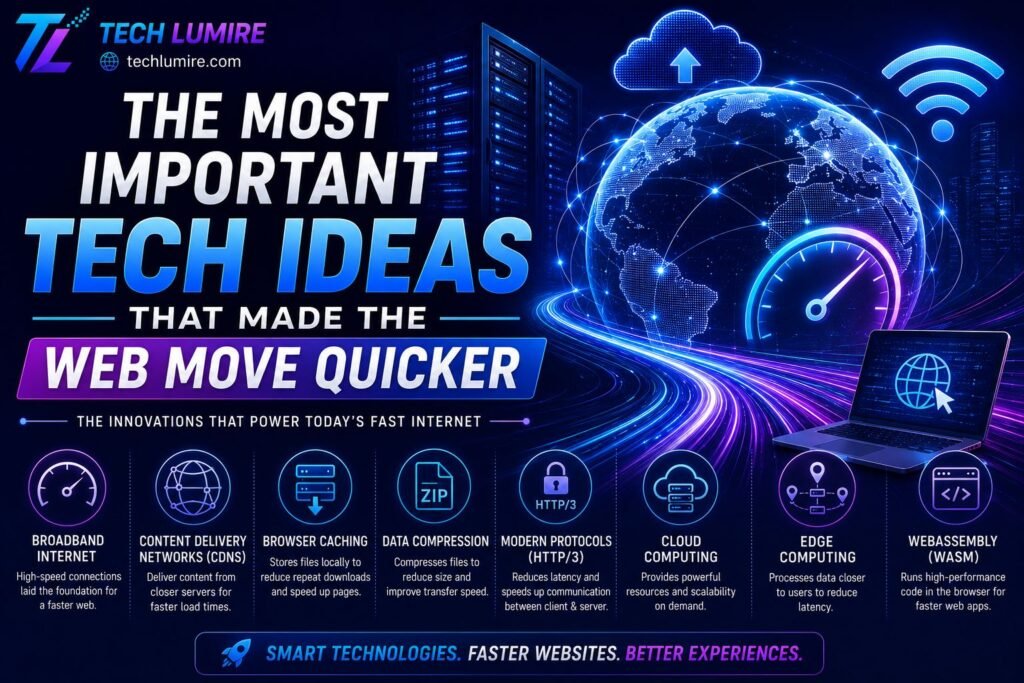
Broadband marked the first major turning point in internet history. Unlike dial-up connections, broadband provided continuous connectivity and significantly higher speeds. Fibre optic technology later pushed performance beyond one gigabit per second, allowing households and businesses to stream videos, download large files, and work online without frustrating interruptions. This breakthrough remains one of the most influential tech ideas that made the web move quicker because every modern online service depends on reliable, high-capacity connections. Supported by fiber optic internet and improved distributed server infrastructure, broadband created the strong foundation upon which today’s digital world continues to grow.
The Most Important Tech Ideas That Made the Web Move Quicker
Distance once slowed the internet more than most people realised. A Content Delivery Network (CDN) solves that challenge by storing website copies across multiple global servers. When you visit a webpage, the nearest server delivers the content instead of one located thousands of miles away. This simple approach became one of the most effective tech ideas that made the web move quicker because it dramatically reduces waiting time. Supported by reduce website latency and global data centres, CDNs help websites load consistently regardless of where visitors live.
Web Caching
Opening the same webpage repeatedly shouldn’t require downloading identical files every time. Web Caching remembers frequently used resources such as images, stylesheets, and scripts. Your browser retrieves those saved files locally instead of requesting them again from the server. As a result, returning visits feel almost instant. This practical innovation remains one of the smartest tech ideas that made the web move quicker because it decreases bandwidth usage while improving browser optimization and faster page load time for millions of websites.
Data Compression
Every webpage contains countless files travelling across the internet before reaching your screen. Data Compression reduces those file sizes without affecting their quality. Modern techniques such as Gzip and Brotli shrink HTML, CSS, and JavaScript files considerably, allowing information to arrive much faster. These efficient methods represent another of the remarkable tech ideas that made the web move quicker because less data always moves faster. Combined with website acceleration and data transfer speed, compression delivers smoother browsing on every connection.
HTTP/2 and HTTP/3
Older internet protocols processed requests one after another, creating unnecessary delays whenever webpages contained numerous resources. HTTP/2 introduced multiplexing, allowing multiple files to travel simultaneously through a single connection. HTTP/3 advanced even further by using the QUIC protocol to minimise connection delays. These upgrades stand among the most influential tech ideas that made the web move quicker, improving server communication and responsive web applications across desktops and mobile devices.
AJAX
Modern websites rarely reload entire pages after every click. AJAX changed web development by allowing browsers to exchange information with servers quietly in the background. Services such as email platforms, online maps, and business dashboards update instantly while users continue working without interruption. This innovation transformed static websites into dynamic experiences, making it one of the revolutionary tech ideas that made the web move quicker. Alongside interactive web pages and real-time web applications, AJAX delivers seamless digital interactions that users now expect every day.
Cloud Computing
Traditional websites relied on a single physical server that often struggled during heavy traffic. Cloud Computing replaced that fragile model with distributed infrastructure spanning multiple data centres worldwide. If one server experiences problems, another immediately takes over without disrupting visitors. This flexibility makes cloud platforms one of the essential tech ideas that made the web move quicker because websites remain fast even during traffic surges. Powered by cloud servers and distributed server infrastructure, businesses now deliver reliable digital services on a global scale.
The Most Important Tech Ideas That Made the Web Move Quicker

Imagine asking a question and receiving the answer from a nearby office instead of one across the world. Edge Computing follows the same principle by processing information closer to users. This approach reduces delays and improves responsiveness for gaming, video streaming, and business software. Among the modern tech ideas that made the web move quicker, edge computing strengthens mobile web performance and delivers a low latency network experience even during heavy demand.
Browser Rendering Engines
Receiving webpage data quickly means little if your browser struggles to display it. Modern rendering engines such as Blink, WebKit, and Gecko convert HTML, CSS, and JavaScript into attractive webpages within milliseconds. Continuous improvements have made scrolling smoother and animations more fluid. These behind-the-scenes advancements remain important tech ideas that made the web move quicker, enhancing browser performance and supporting modern web architecture for every browsing session.
JavaScript Engines and JIT Compilation
Interactive websites rely heavily on JavaScript, yet older browsers executed code much more slowly. Modern engines like Google’s V8 use Just-in-Time compilation to transform JavaScript into machine code while programs run. This clever optimisation allows complex web applications to feel almost native. These innovations rank among the smartest tech ideas that made the web move quicker, improving responsive web applications and web performance optimization across countless online platforms.
Mobile Networks: From 3G to 5G
The internet no longer belongs only on desktop computers. Smartphones became everyday companions because mobile networks evolved rapidly from 3G to powerful 5G technology. Faster wireless speeds and dramatically lower latency allow users to stream, browse, and work almost anywhere. These networking breakthroughs represent essential tech ideas that made the web move quicker, strengthening high-speed internet while improving mobile web performance across the globe.
Core Web Vitals
Website owners once focused mainly on appearance, yet Google shifted attention towards performance by introducing Core Web Vitals. These measurements evaluate loading speed, responsiveness, and visual stability to improve visitor satisfaction. Websites that perform well often enjoy stronger search visibility and happier users. This change made performance one of the defining tech ideas that made the web move quicker, encouraging better SEO page speed and user experience optimization practices throughout the industry.
Modern Image Formats
Large images often slow websites more than any other element. Modern formats such as WebP and AVIF preserve excellent quality while significantly reducing file sizes. Lazy loading adds another advantage by downloading images only when visitors need them. Together, these improvements became practical tech ideas that made the web move quicker, supporting image optimization and creating a faster page load time without sacrificing visual appeal.
WebAssembly (WASM)
Some browser applications now perform tasks once reserved for desktop software. WebAssembly (WASM) allows languages like C++ and Rust to run inside browsers with remarkable efficiency. Video editors, engineering software, and advanced visualisation tools all benefit from this technology. As one of the newest tech ideas that made the web move quicker, WebAssembly expands possibilities while enhancing website performance optimization and interactive web pages.
How These Technologies Work Together
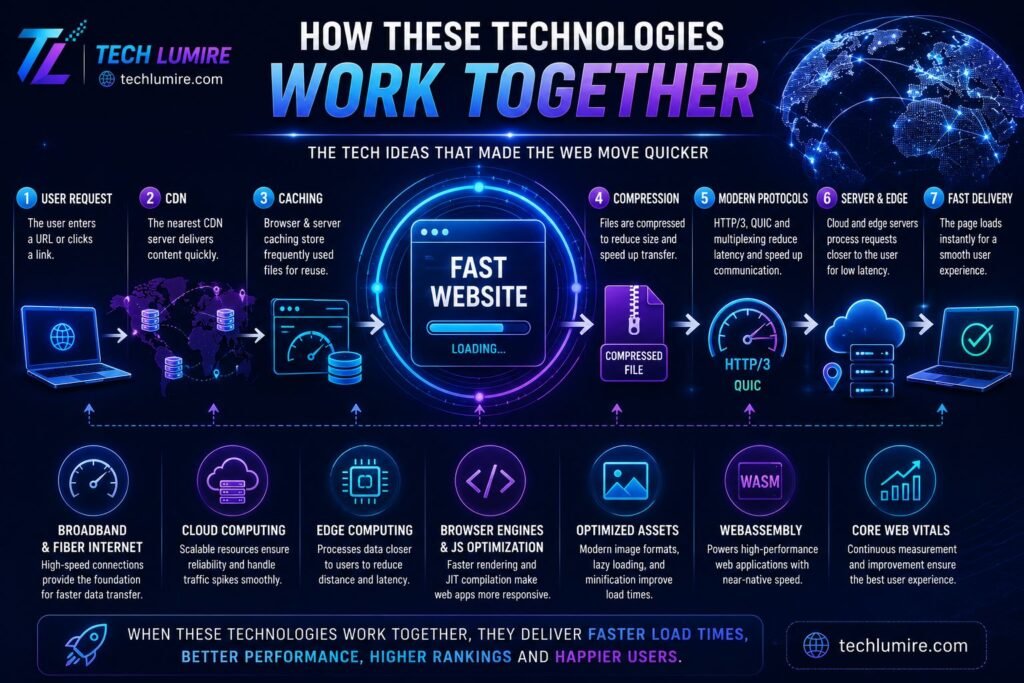
Fast websites don’t rely on one invention alone. Broadband provides the connection, CDNs shorten travel distance, caching eliminates unnecessary downloads, and compression reduces file sizes. Meanwhile, HTTP/3 accelerates communication while rendering engines display content smoothly. Combined, these tech ideas that made the web move quicker create an internet experience that feels effortless and reliable through website loading speed and server response time improvements.
Every layer supports another. Cloud computing distributes workloads, edge computing processes requests nearby, and mobile networks keep users connected wherever they travel. WebAssembly powers demanding applications while Core Web Vitals encourage continuous optimisation. Together, these innovations prove that exceptional performance comes from cooperation rather than a single breakthrough. Modern websites succeed because multiple technologies operate quietly behind every click.
Best Practices to Build a Faster Website in 2026
Improving website speed begins with practical decisions rather than expensive upgrades. Compress files, optimise images, enable browser caching, and choose reliable cloud hosting. Deploying a CDN also reduces latency for global visitors. These proven methods complement the tech ideas that made the web move quicker while strengthening website acceleration and bandwidth optimization for long-term performance.
Developers should also monitor Core Web Vitals regularly and remove unnecessary scripts that slow rendering. Lightweight themes, efficient coding, and faster DNS resolution further improve responsiveness. Small refinements often create noticeable gains because every millisecond matters when competing for user attention and search rankings.
The Future of Web Performance
Innovation continues at an impressive pace. Artificial intelligence now predicts user behaviour, smarter CDNs deliver content more intelligently, and edge AI processes information closer to users than ever before. Future browsers will likely become even faster while consuming fewer resources, ensuring the tech ideas that made the web move quicker continue evolving for years ahead.
Emerging technologies such as predictive preloading, automated image optimisation, and intelligent caching promise another leap forward. Businesses embracing these developments will provide quicker digital experiences, better customer satisfaction, and stronger online visibility as internet expectations continue rising worldwide.
Frequently Asked Questions (FAQs)
What are the 7 advanced technologies?
Artificial Intelligence (AI), Machine Learning, Cloud Computing, Edge Computing, Blockchain, Internet of Things (IoT), and Quantum Computing are among today’s most advanced technologies driving digital innovation.
What are the 10 latest technology trends?
The latest trends include AI, Generative AI, 5G, Edge Computing, Cloud Computing, Cybersecurity, WebAssembly, Extended Reality (XR), Quantum Computing, and Green Technology.
Which technology is best for web development?
JavaScript remains the leading web development technology, supported by frameworks like React, Next.js, Angular, and Vue, along with Node.js for backend development.
What are the 5 best emerging technologies?
The top emerging technologies are Generative AI, Quantum Computing, Edge AI, WebAssembly (WASM), and Extended Reality (AR/VR/MR).
What is the hottest technology right now?
Generative Artificial Intelligence (Generative AI) is currently the hottest technology because it powers advanced chatbots, content creation, coding assistants, and business automation.
Which technology will boom in 2026?
Generative AI, Agentic AI, Edge Computing, Quantum Computing, Robotics, and Web3 technologies are expected to experience significant growth and adoption in 2026.
Conclusion
The internet reached today’s remarkable speed through decades of continuous innovation rather than one revolutionary invention. Broadband, cloud computing, edge computing, WebAssembly, faster protocols, intelligent caching, and efficient image formats all contribute unique advantages. Together, these tech ideas that made the web move quicker transformed the web into a fast, reliable platform supporting communication, entertainment, education, and business. As technology continues advancing, websites will become even smarter, faster, and more responsive, creating richer online experiences for users everywhere.
Explore more Articles
-
 Updates on Software Socials AlienSync: Complete 2026 Guide to New Features, Changes & Best Practices
 -
 Gaming Corner Zap-Internet – The Best Guide to Lag-Free Gaming in 2026
 -
 Updates on Software Socials AlienSync 2026 Guide
 -
 How to Improve LCFTechMods: A Complete Beginner's Guide
 -
 10 Powerful Digital Branding Aggr8Tech Strategies to Grow Your Business in 2026

Shaheer Ahmad is the founder and editor of TechLumire, where he writes about technology, AI, software, cybersecurity, gadgets, and digital trends. His goal is to make complex tech topics simple, practical, and accessible through accurate, well-researched content.